Hiram Davis may have died too young, but he was at least afforded the courtesy of seeing a glowing obituary printed in the Scandia Independent before he succumbed to tuberculosis at the age of forty-nine.
Hiram Davis, one of the very first band of settlers on the White Rock creek, is very low with consumption, and there is no hopes of his recovery. He is on Tom Lovewell's place, near the town of White Rock.
-Republic City News.
We well remember old Hi, as we used to call him in our boyhood days. He used to skirmish up and down White Rock Creek, when it stood a man in hand to keep his eye peeled for Red Skins, and many a scout he had there.
We are indeed sorry to hear of his unfortunate condition.
The Scandia editor’s brief reminiscence, appended to a blurb from the Republic City News, was published on June 21, 1888. What seems to have been Hiram’s only write-up ever to appear in the frontier press, circulated as he lay on his deathbed. He drew his final breath exactly one month later.
According to a list of pioneers prepared for a White Rock Old Settlers meeting in 1884, Hiram Davis did not actually settle along White Rock Creek until 1870, a year after the last recorded Indian raid in Republic County. If the little memoir about his scouting career is accurate, Hiram must have divided his days between his older brother Daniel’s homestead along White Rock Creek, and the town of Clifton in Washington County, where his parents farmed and where White Rock settlers sometimes took refuge during perilous times.
Hiram’s father, Vinson Perry Davis, never fully recovered from an 1867 shotgun blast to his chest, inflicted by peddlers who mistook him for a rival, although it took the patriarch three years to expire. In 1875 Vinson's 60-year-old widow married William Scott from Jewell County. Hiram was still listed as a resident of Clifton in the census that year, along with his wife Mary and their two boys and two girls, a family which would expand within a few years to include three more girls.
Living out his final days at Thomas Lovewell’s farm, Hiram had the occasional company of old friends as well as the care provided by his wife Mary and his younger sister, Orel Jane Lovewell.
There may have been some effort to assemble a color guard at the graveside service for the Civil War veteran, although the local G.A.R. post had long since surrendered its charter. Hiram had likely enlisted in one of three Iowa regiments, the 1st and 4th Cavalry, and the 5th Infantry. There was a Hiram Davis serving in each unit. Two of his younger brothers, Thomas and Ephraim, reportedly died in the war. All three names are listed in the rolls of the 1st Regiment, Iowa Cavalry.
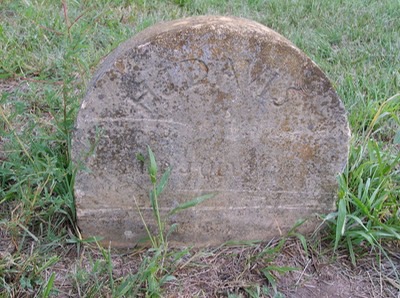
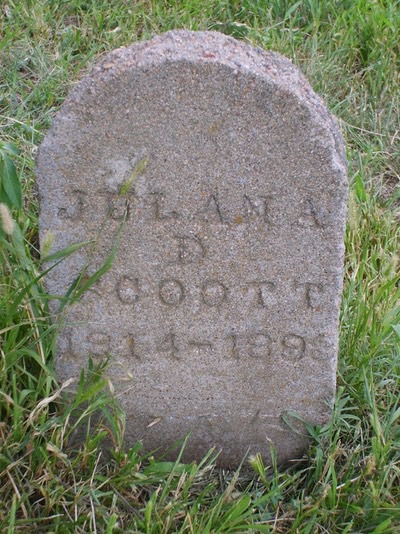
The marker over Hiram’s grave was perhaps the most modest and least expensive available, a small slab of cast concrete with a rounded top. After his mother’s death five years later, she would receive a matching monument, albeit one with her married name misspelled as “Scoott.” Julana would not have minded. Like both of Hiram’s wives, his mother had reached adulthood without learning to read or write, as had Thomas Lovewell’s first wife Nancy, who was Hiram’s aunt.
We do not know what happened to Hiram’s first wife, who at twenty was one year younger than her new husband, according to the 1860 census. She is noted only by an initial, which family historian Rhoda Lovewell interpreted as either “I” or “S.” After returning from the war Hiram remarried, to a girl ten years his junior.
Hiram Davis died a few years before tragedy befell his family, when both of his sons, Eugene and Oran, perished while in their early twenties.
Eugene clung to life for a few weeks after nearly drowning in January, dying February 12, 1894. Oran followed him to the grave forty days later. In her book The Lovewell Family Revisited, Rhoda Lovewell speculates that the boys may have taken an icy plunge together, with both later succumbing to pneumonia, although the historical record is thus far silent on what actually happened to Oren.
A curious coda to the life of Hiram Davis turned up in Iowa thirty-five years after his death. While Bureau of Pensions investigators looked into Orel Jane Lovewell’s application to receive the window’s portion of her husband’s Civil War pension, they picked up a whiff of ancient gossip.
Claimant and soldier are reported to have been well respected in Kansas. In Clarke County, Iowa, Thomas Lovewell and Hiram Davis were believed to have been in the horse stealing business on a very extensive scale and that they made Lacelle, Ia. their hiding place after making a 'shipment.' Lacelle is in a section near Grand River that has been known for many years as Tennessee' and was counted a very lawless locality.
When I first pondered this document well over a decade ago, I wasn’t quite sure what to make of it. For one thing, I didn’t know at the time who Hiram Davis was, other than one of the many sons of Vinson Perry Davis. With everything that has come to light since then, it’s apparent that there is some truth to what was, by that time a 65-year-old rumor, though it probably had nothing to do with the case of Thomas and Orel Jane Lovewell.
A young man named Lovewell was implicated in the horse-stealing business in Iowa, but it was Thomas Lovewell’s little brother Alfred, who was 18 at the time, about a year older than Hiram. In December 1856 Alfred and two associates, Thomas Robinson and William Stewart, broke out of jail in Monroe County, Iowa, where they were being held on charges of horse thievery and housebreaking.
The county seat of Monroe County was Albia, a newly-christened settlement with 400 residents and a tiny log building for a jail, which would need to be replaced the following year, being no match for three sturdy young men. There is no evidence that the suspects were ever recaptured and brought to trial.
With their elders absent in northern Kansas, where they were establishing residency as Free-State voters for the coming election, Hiram Davis and Alfred Lovewell may have convinced themselves that they were doing their own part in the good fight, striking a blow against Iowa “Copperheads” by pilfering their livestock and ransacking their homes.
On the other hand they simply may have been unsupervised teenagers who fell in with the wrong sort. They probably had some explaining to do, after which, everyone agreed on the wisdom of moving further West.